
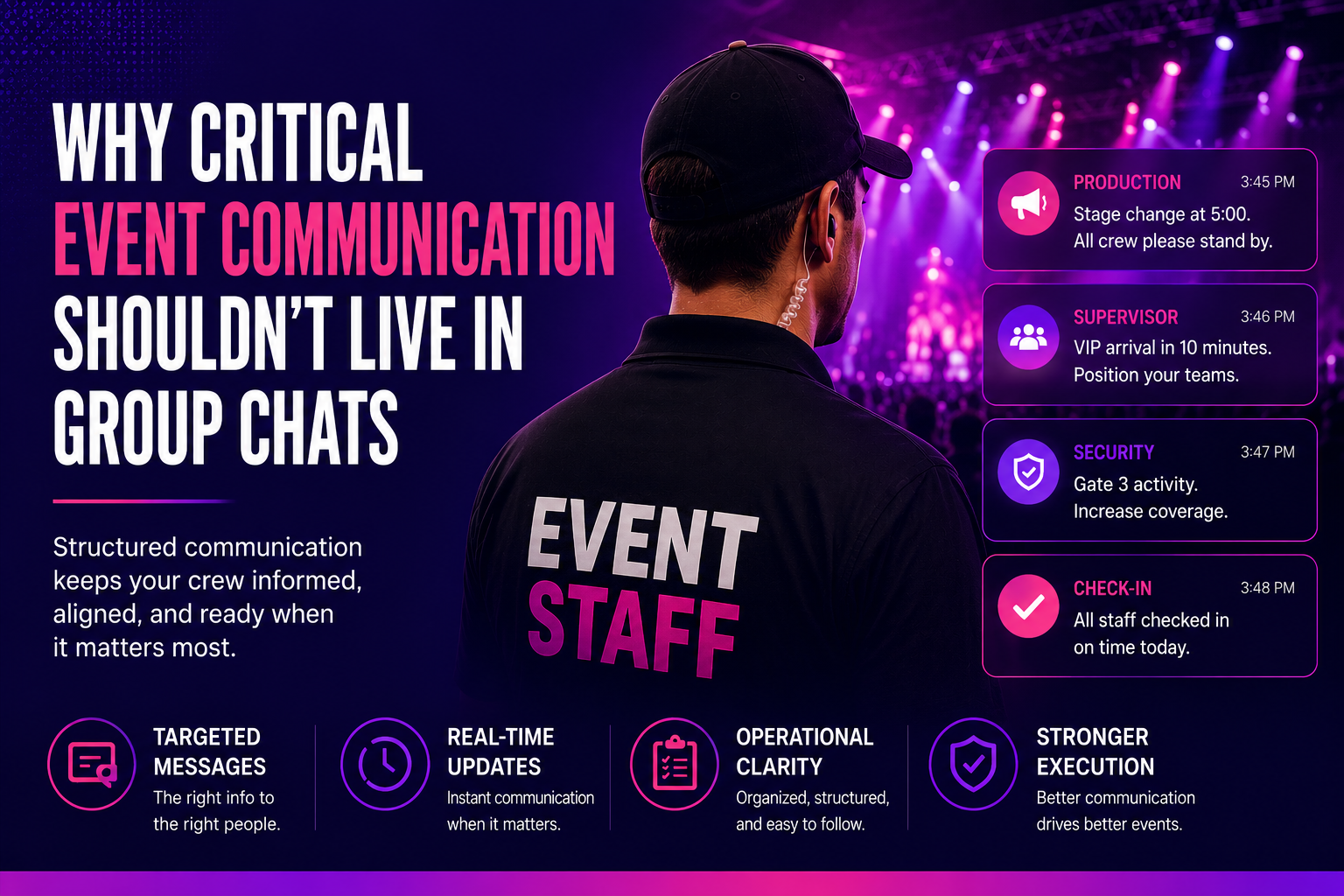
Large events move fast. Supervisors are managing crews across multiple entry points. Production teams are adjusting timelines. Security teams are handling deployments in real time.
In the middle of all that, communication becomes critical.
And while group chats still play an important role in live event operations, they were never designed to handle structured operational communication at scale.
That’s where problems start.
Messages get buried. Important updates get missed. And crews lose visibility into what actually matters.
Modern event teams need more than conversation—they need structured communication built for live operations.
1. Critical Updates Get Lost in Operational Chatter
Group chats are great for quick conversation.
However, event operations generate constant communication throughout the day.
Someone responds:
- “Copy”
- “10-4”
- “On the way”
Suddenly, an important operational update disappears under dozens of responses.
In live events, that creates real issues.
Missed deployment instructions, location changes, or timing adjustments can quickly impact operations across an entire event.
Structured event communication ensures important updates remain visible and organized when teams need them most.
2. Not Every Update Needs to Go to the Entire Crew
One of the biggest communication challenges at events is information hierarchy.
Not every message is meant for every person on site.
Sometimes:
- supervisors need operational direction
- managers need escalation updates
- leads need staffing adjustments
- frontline staff only need deployment details
When every update gets pushed into the same communication stream, crews become overwhelmed with unnecessary chatter.
As a result, critical information becomes easier to miss.
With structured communication tools inside event communication software for live events, teams can target updates to the right people at the right time.
3. Real-Time Operations Require Real-Time Visibility
Event environments change constantly.
Call times shift. Entry plans adjust. Crews get redeployed.
The problem isn’t just sending information quickly—it’s making sure the correct crews actually receive it in real time.
Modern event scheduling software gives managers the ability to communicate instantly with active teams while maintaining operational visibility across the event.
Because of this, supervisors can make faster decisions and crews stay aligned throughout the day.
4. Operational Communication Should Be Structured
Operational messaging is different from casual conversation.
Live event teams need communication that is:
- Organized
- Targeted
- Time-sensitive
- Easy to reference
The right information should reach:
- the right role
- the right shift
- the right location
- at the right moment
That level of structure becomes difficult when communication relies entirely on open group threads.
Structured communication systems reduce confusion and improve operational efficiency across every department.
5. Better Communication Leads to Better Event Execution
The strongest event operations aren’t necessarily the loudest.
They’re the most aligned.
When communication is clear and organized:
- crews respond faster
- supervisors operate with more confidence
- fewer updates get missed
- operations stay under control
This is why modern event teams are moving toward communication systems built directly into their operational workflows.
Conclusion
Group chats still have a place in event operations.
They help teams communicate quickly in the field and support day-to-day operational chatter.
However, critical operational communication requires more structure.
The teams running the smoothest events today are using event scheduling software with built-in communication tools to deliver the right information to the right crews in real time.
Because when communication is organized, operations become easier to manage—and events run smoother because of it.