
As event operations grow, scheduling becomes more complex.
Multiple venues. Multiple cities. Multiple staffing pools.
Without structure, operations quickly become difficult to manage.
That’s why multi-location event teams need scheduling systems built specifically for operational scalability.
1. Scaling Operations Requires Organizational Structure
Large event organizations often manage:
- multiple branches
- regional staffing pools
- separate operational teams
- overlapping events
Without organization, crews become intermingled and operational visibility suffers.
Modern multi-location event scheduling software helps teams structure operations clearly across every market.
2. Master Accounts and Sub-Accounts Improve Operational Control
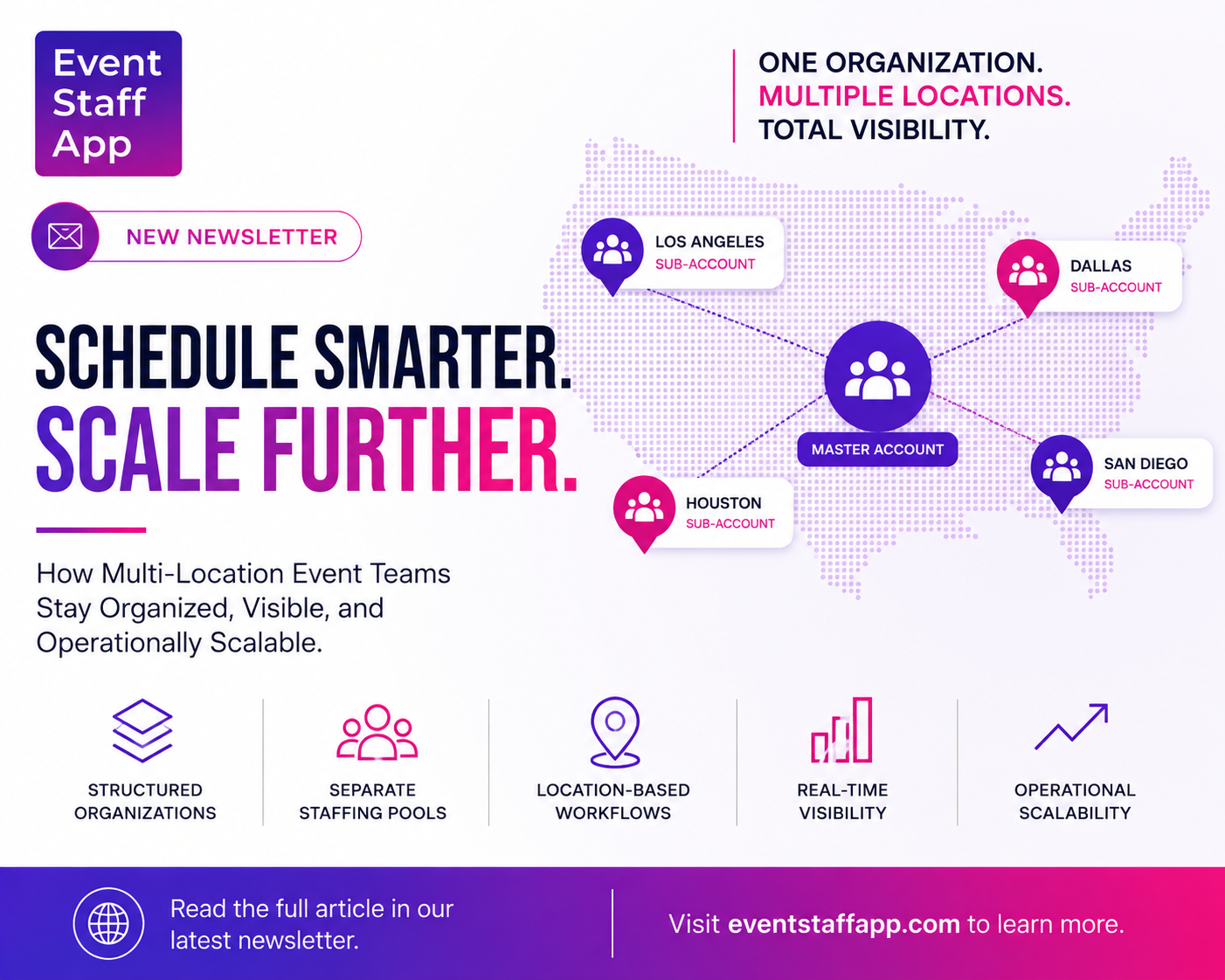
One of the biggest advantages of modern scheduling systems is operational hierarchy.
Organizations can manage:
- a master account
- multiple sub-accounts
- separate staffing pools
- unique operational workflows
This allows regional teams to operate independently while leadership maintains centralized visibility.
3. Separate Staffing Pools Reduce Operational Confusion
Different locations often require different crews.
For example:
- Los Angeles teams
- San Diego teams
- Houston teams
- Dallas teams
Without structured scheduling systems, staff can easily become mixed between operations.
Location-based staffing workflows help teams maintain operational organization while scaling efficiently.
4. Multi-Location Visibility Improves Decision-Making
Leadership teams need visibility across all active operations.
They need to monitor:
- staffing levels
- active events
- operational gaps
- deployment activity
- workforce coordination
Modern scheduling systems provide operational visibility across every location in real time.
5. Scalability Matters More Than Ever
As live event companies grow, operational complexity increases.
Manual systems become harder to manage. Communication becomes fragmented. Operational visibility decreases.
Purpose-built multi-location event scheduling software helps organizations scale while maintaining operational control.
Conclusion
Managing event operations across multiple locations requires more than simple scheduling tools.
Teams need operational structure, visibility, and centralized coordination.
That’s why modern event organizations are investing in multi-location event scheduling software built specifically for scalable live event operations.