
Most operational problems at events happen before guests ever notice them.
Delays build quietly behind the scenes.
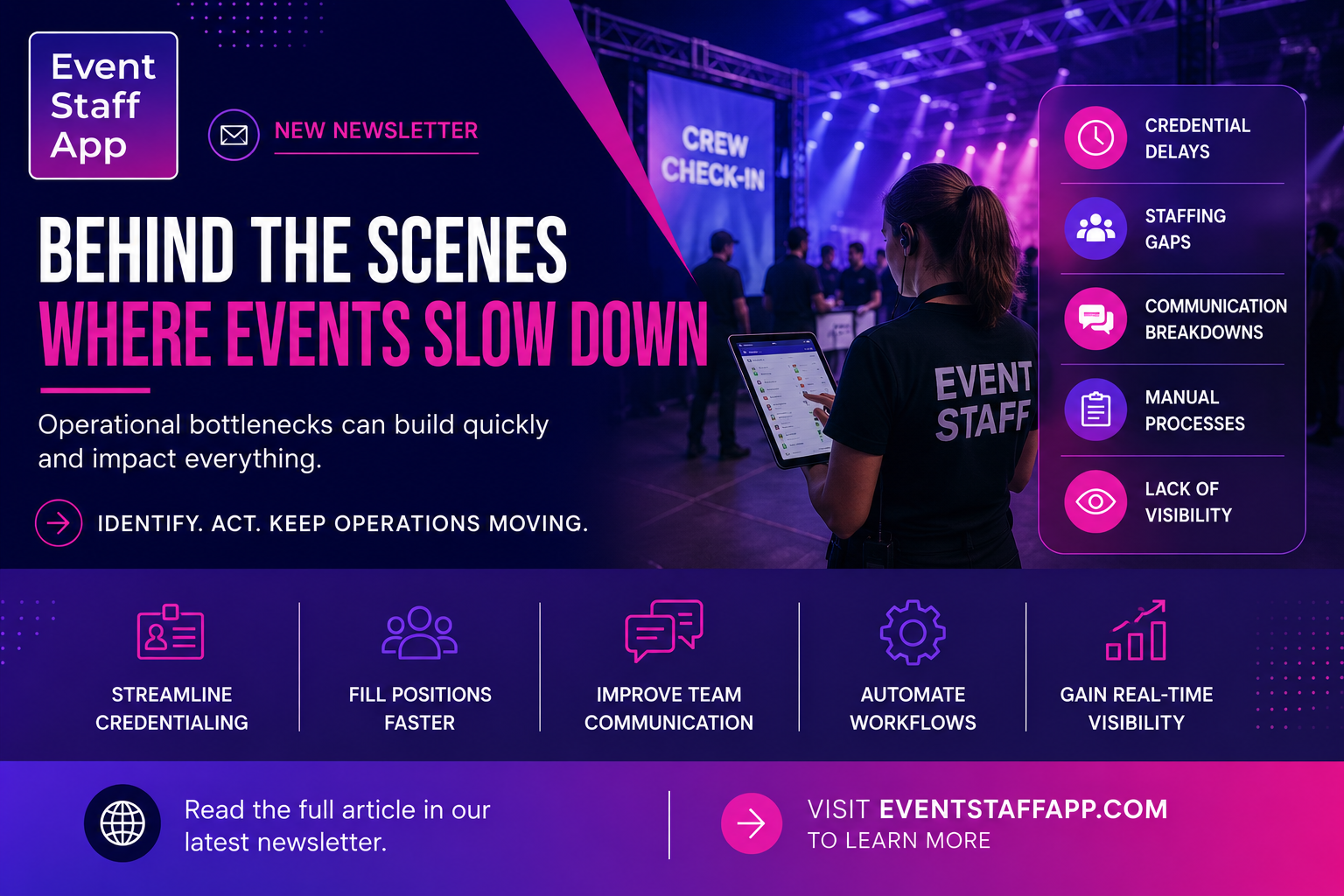
Credential lines slow down. Staffing gaps develop. Communication breaks down.
And when operational bottlenecks stack together, the entire event becomes harder to manage.
1. Credential Delays Slow Down Deployment
One of the biggest operational bottlenecks at large events is credential distribution.
Large operations often involve:
- hundreds of crew arrivals
- multiple access levels
- staggered deployments
- changing operational priorities
Without organization, check-in and credentialing quickly become congested.
2. Staffing Gaps Create Pressure Across Departments
When positions remain unfilled, operational pressure spreads quickly.
Supervisors are forced to:
- redeploy active staff
- stretch operational coverage
- adjust deployment plans
- compensate in real time
That creates additional operational strain throughout the event.
3. Communication Breakdowns Slow Operations
Operational coordination depends on communication.
When updates get missed or delayed, crews lose alignment.
Managers struggle to:
- coordinate deployments
- adjust assignments
- maintain visibility
- respond to operational changes quickly
Structured operational communication helps reduce confusion and improve execution.
4. Manual Processes Create Delays
Many operational bottlenecks are caused by outdated workflows.
Manual scheduling. Paper check-in. Disconnected communication.
These systems slow down operations and reduce visibility across the event.
Modern event operations software helps teams centralize operational workflows in real time.
5. Visibility Helps Teams Solve Problems Faster
The strongest event operations maintain visibility across every operational layer.
Managers need immediate awareness into:
- staffing coverage
- deployment activity
- active crews
- operational gaps
- credential flow
Visibility allows teams to identify bottlenecks early and respond faster.
Conclusion
Large events involve constant operational movement.
Without visibility, communication, and operational structure, bottlenecks become difficult to control.
That’s why modern event teams are using live event operations software to improve coordination, reduce delays, and keep operations moving efficiently.
If you like this article we recommend you check out our article on Event Scheduling Software for Live Events vs. Generic Tools.
Interested in learning more? Book a time to chat with Jordan Hood HERE