
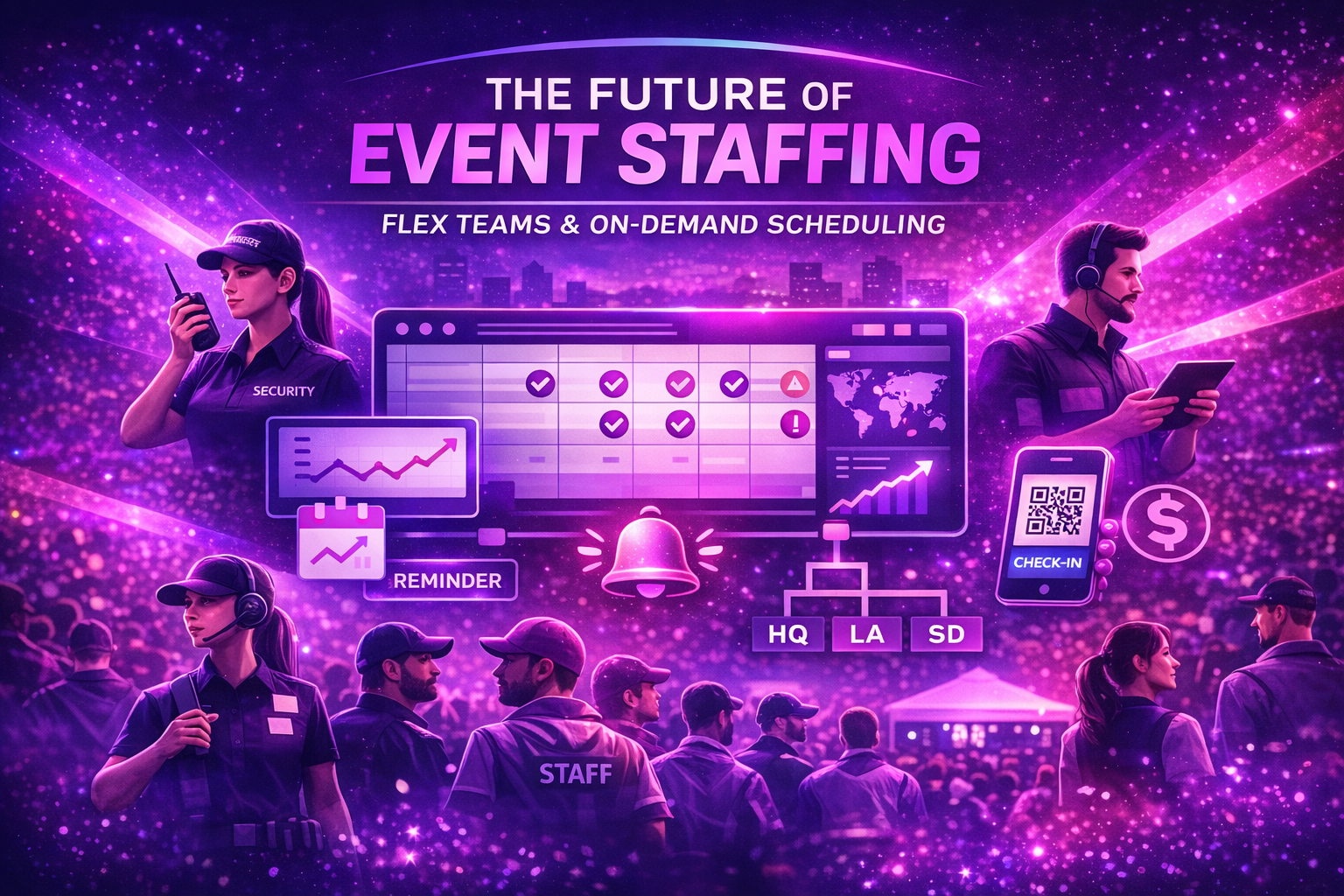
Learn how flexible staffing models and on-demand scheduling are shaping event operations—and how event staff scheduling software helps teams scale efficiently.
Event staffing is evolving.
Today’s events rely on flexible teams—seasonal staff, freelancers, and contractors who scale up and down based on demand. Whether you’re supporting a stadium, festival, corporate activation, or private event, the ability to adjust your workforce quickly is essential.
But managing that workforce efficiently comes down to one thing:
How you schedule them.
That’s where modern event staff scheduling software plays a critical role.
Here’s how event teams are adapting to flexible staffing models with better scheduling systems—without adding operational chaos.
1. Create Reusable Positions for Rapid Scheduling
When demand spikes, speed matters.
Instead of rebuilding roles from scratch for every event, teams can create reusable positions based on role, skill set, and location. For example:
-
Bartender – San Diego
-
Security – Gates
-
Production Crew – FOH (Front of House)
-
Production Crew – BOH (Back of House)
-
Production Crew – Stages
This structure allows managers to schedule the right staff quickly and accurately, without sending out broad or inefficient outreach.
Staff can also be assigned to multiple positions, giving you the flexibility to schedule based on experience, location, or event needs—without being locked into a single role.
Additionally, teams can copy and reuse entire events, including positions, call times, and structure—making it easy to schedule recurring events without starting from zero.
2. Offer Multiple Check-In Methods
Flexible teams require flexible check-in.
Modern event staff scheduling software supports:
-
QR code check-in
-
Admin or supervisor check-in
-
Mobile self check-in
This ensures teams can manage arrivals efficiently while keeping operations organized and attendance accurate.
3. Automate Scheduling Confirmations and Reminders
One of the biggest challenges with flexible teams is reliability.
Event staff scheduling software helps solve this by:
-
Sending schedules directly to staff for confirmation
-
Tracking who has confirmed vs. who hasn’t
-
Sending weekly reminders for upcoming shifts
-
Sending 24-hour reminders before call times
This reduces no-shows, improves punctuality, and gives managers full visibility into who is scheduled and confirmed.
4. Track Scheduling Fill Rates and Gaps in Real Time
In live event environments, visibility is everything.
Managers need to know instantly:
-
Which positions are filled
-
Which scheduled roles still need coverage
-
Who has checked in on-site
Real-time dashboards allow teams to adjust scheduling decisions on the fly and ensure every role is covered before it impacts operations.
5. Maintain Payroll-Ready Scheduling Records
Post-event reconciliation can slow teams down.
With accurate clock-ins and shift logs, event staff scheduling software ensures payroll is clean, consistent, and easy to export.
This reduces manual work, eliminates errors, and keeps operations running smoothly after the event ends.
6. Structure Teams with Master Accounts and Sub-Accounts
As operations grow, organization becomes just as important as speed.
Modern event staff scheduling software allows organizations to operate with a master account and sub-accounts, making it easier to manage scheduling across multiple locations.
For example:
-
Corporate (Master Account)
-
Los Angeles (Sub-Account)
-
San Diego (Sub-Account)
-
San Francisco (Sub-Account)
Each sub-account can manage its own:
-
Staff pool
-
Positions
-
Events
-
Scheduling workflows
This ensures teams are never intermixing staff across locations unless intended—while still giving leadership full visibility across all scheduling operations.
Why Flexible Staffing Requires Better Scheduling
Flexible staffing isn’t the challenge—managing it efficiently is.
As events become more dynamic, teams need scheduling systems that can keep up.
The combination of:
-
Flexible staffing models
-
Real-time scheduling updates
-
Automated confirmations
-
Centralized scheduling systems
Is what allows modern event teams to operate efficiently at scale.
Conclusion
Flexible staffing is here to stay—but success comes down to how well you schedule your team.
With the right event staff scheduling software, you can manage dynamic crews, scale across multiple locations, and maintain full control over your operations—without adding complexity.
If you are interested in learning more please find time to connect HERE.